
 Lance Avery Morgan
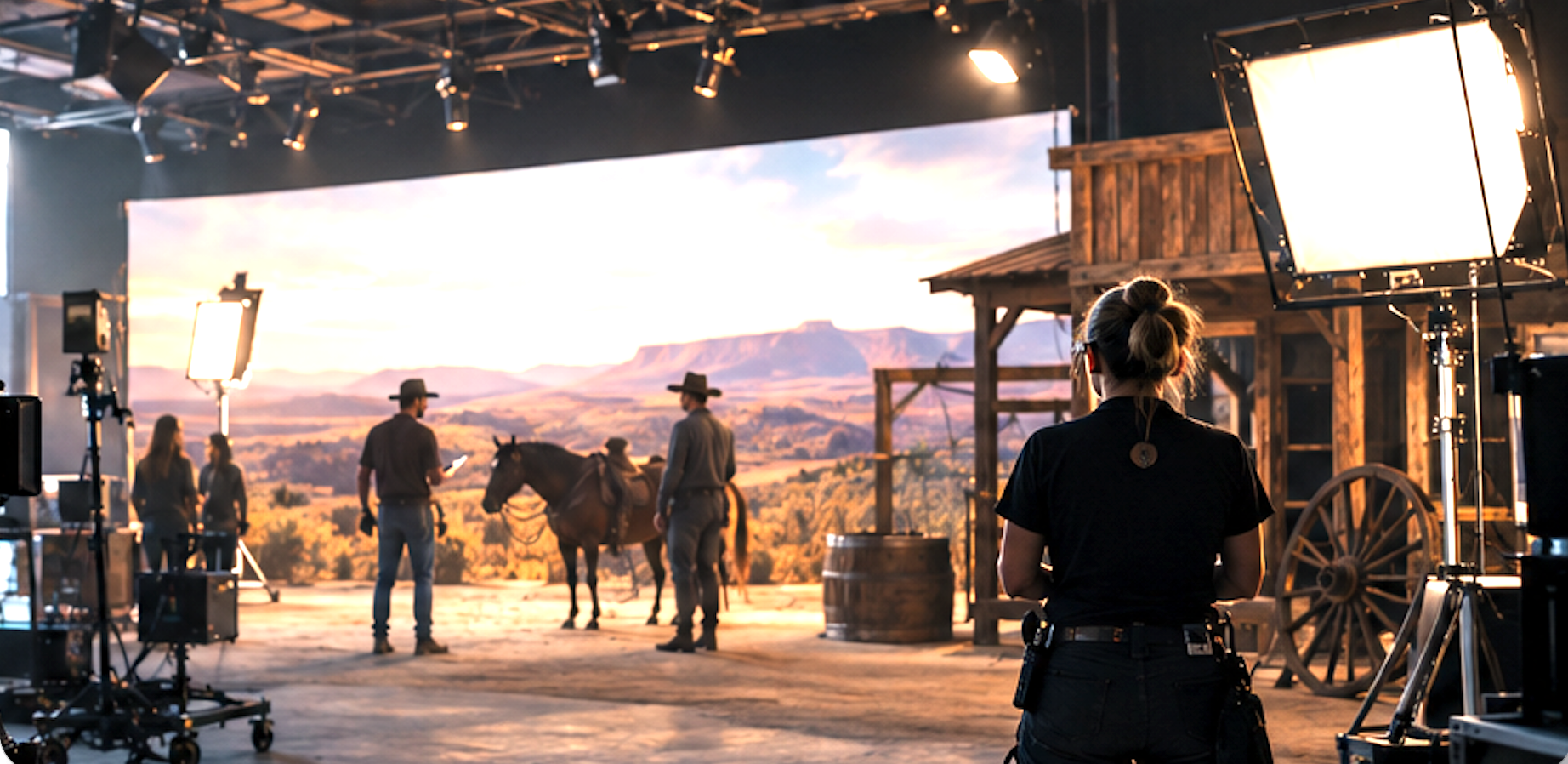
From Hollywood To The Hill Country: Could Skydance Officially Put Austin On The Studio Map?
Paramount, shortly to be renamed Skydance Studio, the newly combined entertainment company formerly known as Paramount Studios, reported interest in an East Austin studio site, which could signal a transformative new chapter for Texas entertainment. From the Bluebonnet Business Center to the possibilities of Williamson County, here’s what a Hollywood-scale arrival could mean for jobs, creative talent, and the future of the Austin region, as our entertainment industry follower Lance Avery Morgan shares.
Think about this as your thinking about the future. What happens when Hollywood starts looking to Texas not simply as a place to shoot a movie, but as a place to build its future?
Austin may be about to find out.
The Texas capital has long been a magnet for filmmakers, musicians, actors, writers, technology entrepreneurs, and creative visionaries. In his 2002 book The Rise of the Creative Class, Richard Florida named Austin one of the top three creatively influential cities in the country, noting how talent and young graduates were gravitating toward the Capital City. Fast forward to now, a major entertainment-industry investment by Paramount and its parent company, Skydance, could elevate Austin’s position on the national stage in a particularly consequential way.
Reports published in August 2026 indicated that Paramount Skydance was exploring Austin as a potential new base of operations, with discussions reportedly involving a substantial facility at Bluebonnet Business Center in East Austin. The Bluebonnet Business Center website lists Building 4 at approximately 414,797 square feet, not the entire complex. The full four-building development totals approximately 684,344 square feet.
The possibility emerged amid a turbulent period for the entertainment conglomerate, including its acquisition of Warner Bros. Discovery, for a cool $110 billion and a high-profile dispute over the future of its California operations, according to the Austin Business Journal.
However, there is an important distinction between an intriguing prospect and a signed deal. As of October 14, no publicly verified announcement confirms that Paramount/Skydance has committed to relocating to Austin or leasing the reported property. Yet we understand that a recent high-level meeting with key Texas politicos and Hollywood representatives was held to help “greenlight the deal,” in show biz parlance.
Still, the question is compelling: Could Austin become the next major address in American entertainment?
And if it does, will the impact extend far beyond the cameras and soundstages?
Potential New Chapter For A Hollywood Powerhouse
The timing makes this story especially fascinating.
On October 6, 2026, Skydance announced it had completed its acquisition of Warner Bros. Discovery, bringing together two major film studios, streaming platforms, television networks, news organizations, and extensive entertainment libraries under the combined company, Skydance. The company has outlined an ambitious production strategy, including a commitment to release at least 30 theatrical films annually, according to an October 6 announcement by Skydance.
This is no longer simply a story about a traditional Hollywood studio considering a change of scenery. It is about a newly consolidated entertainment enterprise navigating an industry being reshaped by streaming, technology, changing audience habits, production economics, and the search for new business models.
Under Chairman and CEO David Ellison, the company has emphasized a future powered by creativity, technology, and global scale.
Could Texas become part of that strategy? Hmm…
Several reasons make the prospect worth attention.
California remains home to an extraordinary concentration of entertainment talent, established studios, unions, production vendors, and industry expertise. Relocating a major production operation would therefore be a complicated logistical undertaking, not merely a matter of finding a large building in another state.
Yet companies continually reassess where they invest, how they operate, and where their next phase of growth makes the most business sense. Texas has increasingly positioned itself as an attractive destination for major employers, technology companies, and creative enterprises.
For a company seeking to combine production, technology, and new ways of working, Austin offers an intriguing proposition.
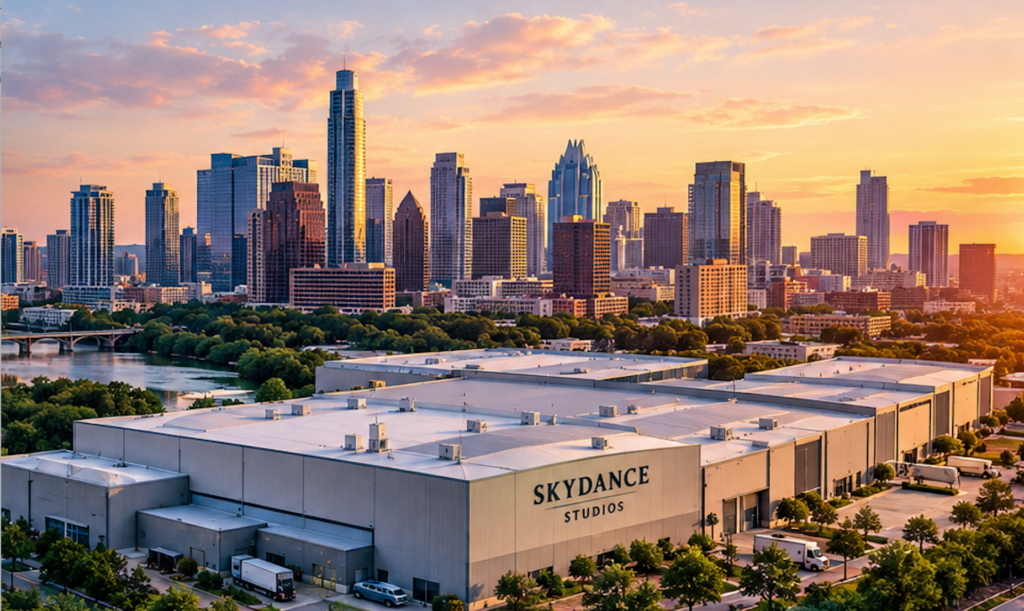
The Bluebonnet Business Center: Hollywood’s Potential New Texas Address?
One location has captured particular attention: Bluebonnet Business Center, at 9219 Old Manor Road in Northeast Austin.
The property’s fourth building offers approximately 414,797 square feet of space, according to the development’s official website. The larger, four-building industrial complex totals approximately 684,344 square feet. Developed by Hines, the property benefits from access to U.S. Highway 290, U.S. 183, and State Highway 130, with proximity to Austin-Bergstrom International Airport and major regional employment centers, according to the venue’s website.
For a traditional industrial tenant, those specifications suggest logistics and distribution. For an entertainment company, the possibilities and the questions are different.
Could a building of this scale accommodate production offices, equipment storage, set construction, postproduction facilities, or specialized stages? Potentially, depending on its configuration, structural suitability, permitting, investment, and the company’s intended use.
Could it become a full-fledged movie and television studio?
That would require considerably more investigation.
A modern production facility may need extensive electrical capacity, specialized sound isolation, sophisticated lighting and rigging, high-capacity cooling, fire protection, soundstages, production support areas, and substantial space for crews, vehicles, equipment, and sets. A large industrial footprint does not automatically translate into a turnkey film studio.
The distinction matters. The reported property could serve as an operational base, a production-support hub, or part of a broader studio strategy. Whether it could accommodate the full range of a major studio’s production needs would depend on a detailed feasibility assessment.
The location nevertheless has an intriguing geographic advantage. Northeast Austin is within reach of the airport and major transportation corridors, and it is near established technology and manufacturing employers. The surrounding area also has a connection to Austin’s filmmaking community, including Troublemaker Studios, founded by renegade filmmaker Robert Rodriguez.
If a substantial entertainment operation were established at Bluebonnet, it could create an entirely new dimension for an area more commonly associated with industrial development and technology.
It could also place East Austin at the center of a conversation about how the region grows, attracts investment, and creates opportunities for its residents.
Or Could Hollywood Aim North To Williamson County?
Bluebonnet isn’t the only conceivable Texas scenario. Imagine this.
Williamson County, north of Austin, offers another geographic possibility worth considering as the region evaluates its long-term potential as a production destination. However, no verified public announcement has established Williamson County as a competing finalist or confirmed that Paramount/Skydance is actively pursuing a specific property there. It is, however, a possible regional development scenario, not a confirmed competing site.
The broader question is whether a major entertainment company would prefer to adapt an existing building or develop a purpose-built campus.
A large, existing facility can offer a faster route to establishing an initial presence, assuming the building meets the company’s requirements and the necessary approvals can be obtained. A purpose-built campus, by contrast, could provide greater flexibility for soundstages, backlots, production offices, workshops, parking, and future expansion.
Williamson County could merit consideration for a development requiring a larger contiguous site, subject to land availability, infrastructure, zoning, workforce access, and financial feasibility.
Its appeal would also depend on the kind of operation being contemplated. A corporate headquarters, a production-services hub, and a comprehensive studio campus have very different land, building, transportation, and staffing requirements.
For now, the East Austin property has a specific address and reported negotiations behind the headlines. Williamson County represents a broader question about where the next generation of Texas entertainment infrastructure might take shape.
The two possibilities should not be mistaken for confirmed alternatives in an active site-selection process.
Why Austin? The Creative Capital Argument
Austin would not be starting from scratch since it’s been ready for its close-up for decades.
The city has spent decades developing a filmmaking identity grounded in independent cinema, unconventional storytelling, entrepreneurial energy, and a strong relationship between artists and audiences.
The Austin Film Society, founded by fan-favorite film director Richard Linklater in 1985, has helped cultivate that culture through screenings, filmmaker support, and production facilities at Austin Studios. The organization reports that Austin Studios has supported hundreds of productions and generated substantial economic activity across the region, according to the good folks at Austin Film Society, who also created the Texas Film Awards.
The wider region also offers a diverse array of landscapes, from urban architecture and contemporary neighborhoods to Hill Country scenery, historic small towns, and expansive ranches. Those settings can serve a broad range of film and television productions.
And then there’s the talent.
Austin’s creative community includes directors, screenwriters, cinematographers, editors, actors, composers, photographers, designers, musicians, production companies, and independent entrepreneurs. Its technology ecosystem offers additional expertise in software, digital production, visual effects, and emerging media tools. It seems like a truckload of formerly-based Hollywood talent drops off almost weekly. We encourage them to bring their creativity and entrepreneurial spirit.
That combination is particularly relevant as entertainment and technology become increasingly intertwined.
A major studio presence could connect these communities to larger production budgets, more consistent work, national distribution networks, and new professional relationships.
But the opportunity is not simply to import Hollywood.
The greater prize would be to create an environment in which Texas talent can build careers, develop original intellectual property, and tell stories that might otherwise be produced elsewhere.
The Jobs Question: Beyond The Stars On The Red Carpet
When people imagine a major studio arriving in town, they often picture movie stars, premieres, and glamorous productions. We already get a taste of that with SXSW, ACL, ATX TV Festival, Moontower Comedy Festival, and other celebrity-centric gatherings.
According to insiders, the economic impact, however, could begin with far less visible work.
A substantial production operation could generate opportunities across a wide range of occupations, depending on its scale and the activities ultimately established in Austin.
Potential roles and business opportunities could include:
- Production crews: Assistant directors, camera operators, lighting technicians, grips, sound professionals, script supervisors, and production coordinators.
- Construction and design: Set builders, carpenters, scenic artists, fabricators, painters, prop makers, and production designers.
- Postproduction and technology: Editors, colorists, sound mixers, visual-effects specialists, digital artists, and technical engineers.
- Wardrobe, hair, and makeup: Costume designers, stylists, wardrobe supervisors, and makeup professionals.
- Business and administration: Finance, legal services, human resources, marketing, public relations, facilities management, and operations.
- Local suppliers: Equipment-rental companies, transportation providers, caterers, security firms, printing businesses, hotels, and other vendors.
The ripple effects could extend to restaurants, retail businesses, residential property, and hospitality providers when productions bring crews, executives, and visiting talent to town, as they do when major festivals happen here.
Nevertheless, the size of that impact would depend on how much activity actually moves to Texas. A corporate office staffed primarily by existing employees would produce a different economic result from a fully operational production campus hiring local crews and supporting multiple productions throughout the year.
It is also important to distinguish permanent jobs from temporary production assignments, construction employment, and indirect economic activity.
The most meaningful measure isn’t simply how many jobs are announced, but how many are created locally, how long they last, what they pay, and whether they offer a sustainable path into the entertainment industry.
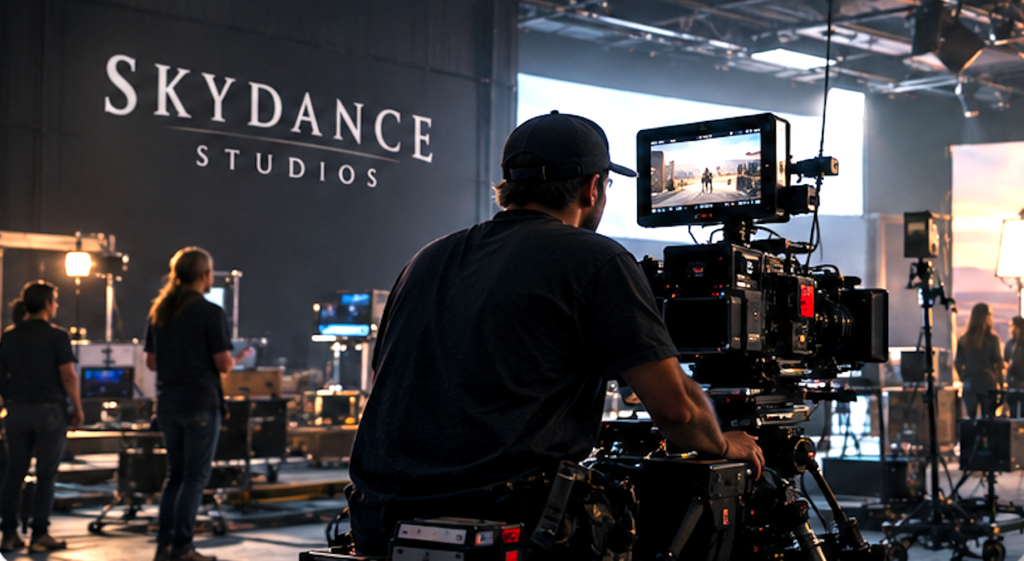
So, What About Austin’s Creative Class?
For Austin’s established creative community, a major studio could represent both an extraordinary opportunity and a complicated challenge.
More production activity could mean more paid work for independent filmmakers, actors, writers, musicians, and technical professionals who have often needed to travel elsewhere to pursue larger projects.
It could also help strengthen the network of local companies providing equipment, casting, editing, set construction, and other production services.
The potential extends beyond feature films and television series. Commercial production, branded entertainment, animation, digital storytelling, and technology-driven production could all benefit from a stronger regional ecosystem, depending on the company’s eventual plans.
Yet there’s another side to consider.
Austin’s creative identity has been shaped by independent voices, experimental storytelling, small production companies, and the freedom to take artistic risks. A larger corporate presence could bring investment and opportunity, but it could also intensify competition for production space, skilled workers, and commercial real estate.
The challenge would be ensuring the benefits reach beyond the largest players.
Could local filmmakers access the new facilities? Would the company invest in internships, apprenticeships, film education, and workforce development? Could smaller production companies become vendors or partners? Would emerging Texas writers and directors have a pathway to pitch original projects? The short answer seems yes to all.
Those questions could determine whether a major studio’s arrival becomes a transformative moment for the entire creative community or primarily a corporate real estate story.
The Texas Advantage… And The Fine Print
Texas has several advantages that could strengthen its case.
The state offers a substantial business environment, access to major transportation networks, a growing population, a broadening technology sector, and a variety of locations suitable for filming. Austin also has an international profile built around film, music, festivals, technology, and entrepreneurship. The new Texas Stock Exchange shows financial circles are adopting Texas as its new home up the road in Dallas.
Texas also offers a film incentive program, although eligibility, funding availability, qualifying expenditures, and program requirements must be evaluated against the specific production and investment being proposed.
Those incentives matter because film production is highly mobile. Productions can compare locations based on costs, available crews, facilities, incentives, logistics, and the practical demands of a particular project.
Still, the argument that Texas is automatically a cheaper or easier alternative has limits.
California’s established production ecosystem is difficult to replicate. A studio moving substantial operations would need to consider experienced crew availability, union agreements, soundstage capacity, specialized suppliers, and the costs of relocating employees or recruiting replacements.
Austin would also need to address the practical consequences of growth: housing affordability, transportation, infrastructure, and access to training.
A successful strategy would require more than a compelling location and an attractive business climate. It would require sustained investment in people, facilities, and the broader production ecosystem.
What Would It Really Mean For Austin’s Economy?
The potential benefits could extend well beyond the entertainment sector.
A major studio investment could increase demand for commercial real estate, construction, transportation, hospitality, and specialized business services. It could strengthen Austin’s national profile as a place where creative industries and technology intersect more avidly.
It might also attract additional companies seeking proximity to production facilities, including postproduction firms, equipment suppliers, talent agencies, and technology businesses developing new entertainment tools.
But the distinction between economic opportunity and economic certainty is essential.
No reliable estimate of jobs, investment, tax revenue, or regional economic impact is possible until the company’s plans, investment commitments, production schedule, and staffing requirements are known.
Local officials and economic-development leaders should assess any proposed incentives against measurable public benefits, including permanent employment, workforce training, local supplier participation, and the durability of the investment.
For residents, the question is straightforward: Would this investment create opportunities that are accessible to Texans and worthwhile for the region over the long term?
The answer should be measured in more than headlines.
Could Austin Become Hollywood’s Next Great Production Hub? To Many, Here’s Hopin’…
It is an exciting possibility, but a major studio’s arrival wouldn’t automatically make Austin the next Hollywood.
The entertainment industry is built on relationships, infrastructure, expertise, financing, distribution, and a steady pipeline of productions. A single facility, even a very large one, cannot reproduce all the advantages of an established production center overnight.
What it could do is accelerate Austin’s evolution.
With the right investment, the city could become a stronger destination for productions that combine Texas locations, local talent, modern facilities, and advanced technology. Over time, that could help build a deeper, more resilient entertainment economy.
And Austin has a compelling foundation to build on: a history of independent filmmaking, a strong creative identity, an expanding technology sector, and a regional economy capable of supporting new industries.
The opportunity would be greatest if the region treated a major studio not as an isolated corporate arrival, but as a catalyst for a larger creative strategy.
That would mean connecting employers with schools and universities, strengthening workforce programs, supporting independent filmmakers, encouraging local businesses to join production supply chains, and ensuring growth does not price the creative community out of its own city.
The Final Cut: A New Texas Love Story?
For now, the possibility of Paramount/Skydance establishing a substantial presence in Austin remains a developing story, not a confirmed relocation.
The Bluebonnet Business Center offers a concrete location to watch. Williamson County presents a broader question about the region’s capacity to accommodate future entertainment development. And the newly combined Skydance enterprise faces strategic decisions that will shape its next chapter.
Whether the eventual result is a production hub in East Austin, a different regional site, or no relocation at all, the discussion has already raised an important question about Texas’s future.
Austin has long attracted people who want to create something new. A major studio could bring additional capital, professional opportunities, and global visibility to that existing culture.
The real measure of success, however, would be whether the region can translate a high-profile corporate investment into enduring opportunities for the people who make stories possible.
Hollywood has always understood the power of a compelling setting. Texas has the landscapes, the talent, and the ambition.
The next chapter will depend on what gets built, who gets hired, and which stories ultimately make it to the screen.