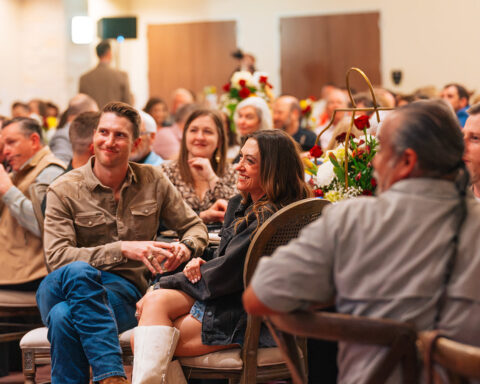
 Jennifer Satterfield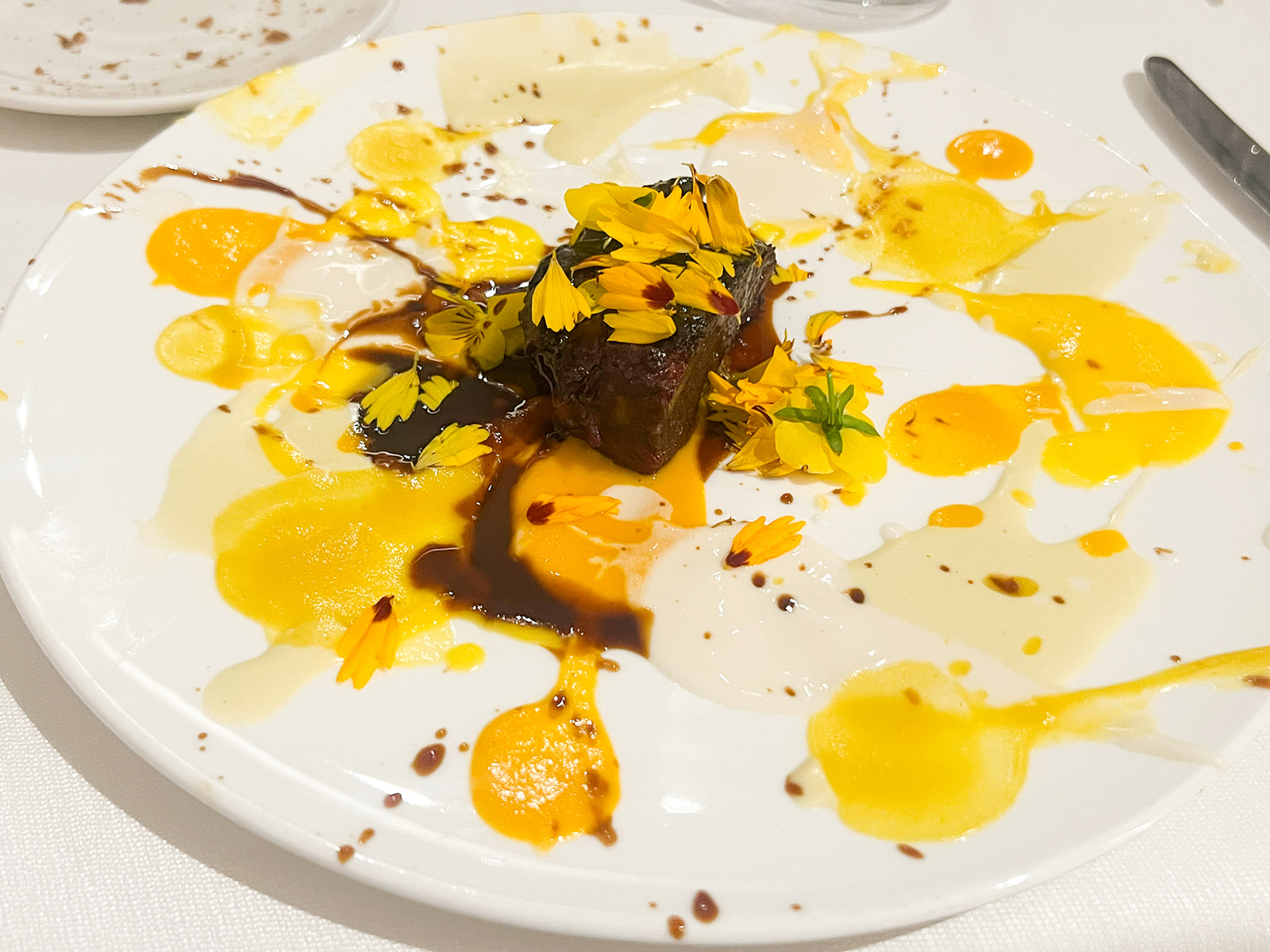
Some Regions In Italy Announce Themselves With Monuments. Emilia-Romagna Does It In The Dining Room
The road from Parma to Modena is not long, at least not by Texas standards, but it has a way of stretching time. The distances are short, the meals are not, and every village seems to have one more thing worth pulling over for. A caseificio turning morning milk into Parmigiano Reggiano. A family-run acetaia where balsamic vinegar ages in wooden barrels, some older than the United States. A glass of Lambrusco poured with the confidence of a wine that has never needed an explanation.
We had come to the region with an itinerary that moved through Parma, Torrechiara, Modena, Maranello, Nonantola, and the surrounding countryside, with food stops woven between the more mechanical attractions of Italy’s Motor Valley. My husband was here for the cars, motorcycles, and back roads, but the real history was on the table: a walking tour through Parma, lunch at the base of Torrechiara Castle, dinner in Modena, a meal at Cavallino, a Lambrusco winery dinner, a Parmigiano Reggiano dairy visit, and a stop at Acetaia Pedroni and Osteria di Rubbiara outside Nonantola.
Eating My Way Through Italy’s Emilia-Romagna: Parma to Modena
Parma makes a fitting first course. It is one of those Italian cities that feels civilized without being overly polished, the sort of place where the architecture reminds you to walk slower and the shop windows remind you that restaurant need be the only reason to make travel plans. UNESCO named Parma a Creative City of Gastronomy in 2015, and the designation feels less like a badge than a simple acknowledgment of what the city already knows about itself. Food here is not lifestyle theater. It is civic identity.
You feel that in the rhythm of the streets. Parma does not need to shout about prosciutto, pasta, cheese, or wine. It simply lets you notice them. A walk through the historic center becomes a gentle introduction to the larger region, where the line between agriculture and culture is practically nonexistent. The countryside is never far away. Neither is the next meal.
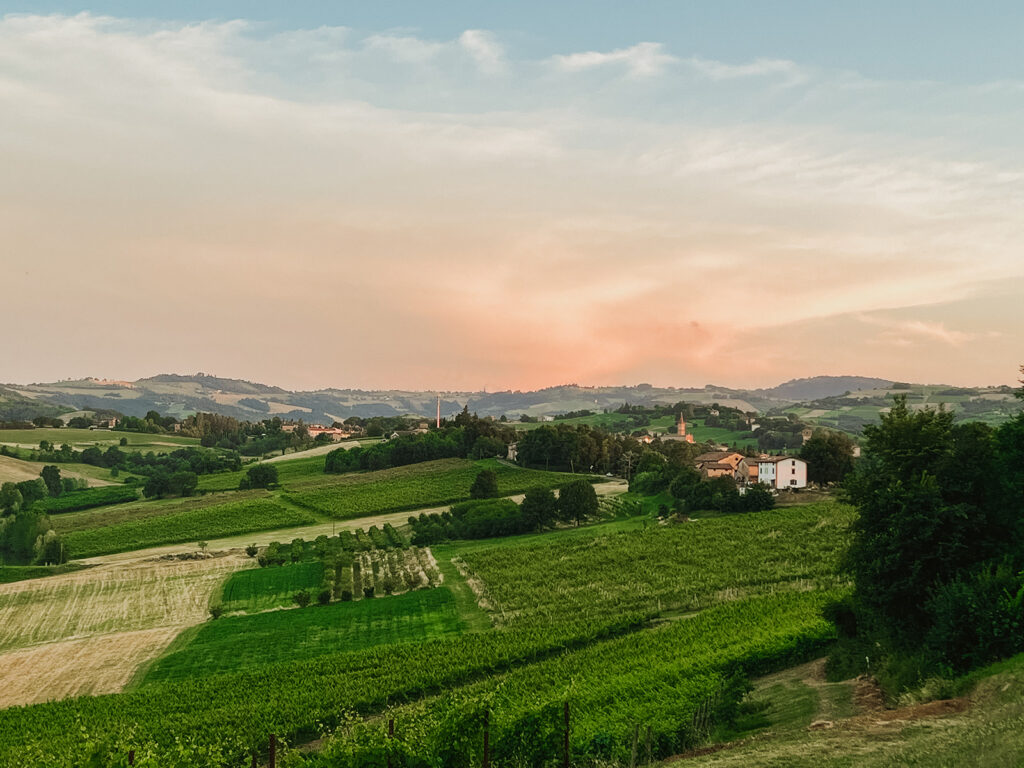
From Parma, the road bends toward Torrechiara, where the castle rises over the hills of Emilia-Romagna like an illustration from an old travel book. It is the kind of place where lunch should be unhurried and full of local logic. Emilia-Romagna’s greatness is not built on novelty. It is built on repetition done well, generation after generation, until a few simple ingredients become cultural shorthand.
That idea follows you into Modena.
Modena has a different tempo from Parma. It is more compact, more intense, more prone to making a visitor believe that every side street might lead to either a perfect plate of tortellini or a world-changing idea. Often, both. The city’s food culture carries a confidence that borders on theological. Pasta is not just pasta. Balsamic vinegar is not just vinegar. Parmigiano Reggiano is not just cheese. These are historical documents, written in milk, grape must, flour, egg, patience, and weather.
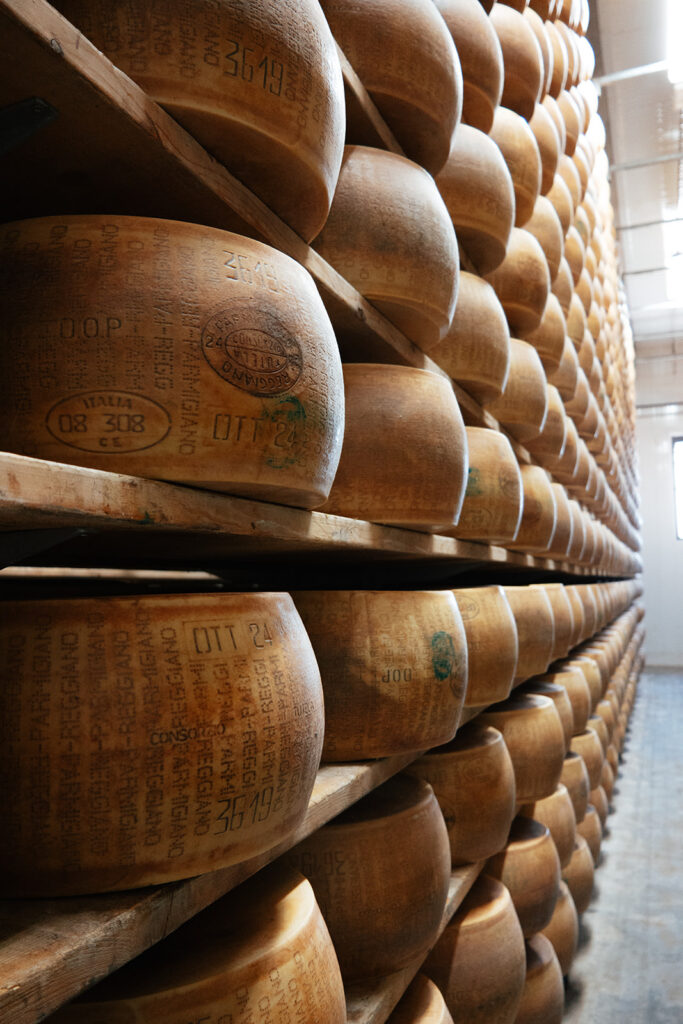
The clearest example came inside a Parmigiano Reggiano dairy, where the romance of Italian food meets the discipline of a laboratory. Parmigiano Reggiano is tied tightly to its place of origin. The milk, cheese-making, minimum maturation, and packaging all take place within a defined area that includes Parma, Reggio Emilia, Modena, part of Bologna, and part of Mantua.
Watching the process gives the cheese a new gravity. The copper vats, the curds, the wheels resting in long, orderly rows, the official markings pressed into the rind: it all feels both ancient and exact. Visit Modena’s tourism office says the best way to understand Parmigiano Reggiano is to visit a cheese factory, where tours often follow the production process and end with tastings of what it rightly calls the “King of Cheeses.”
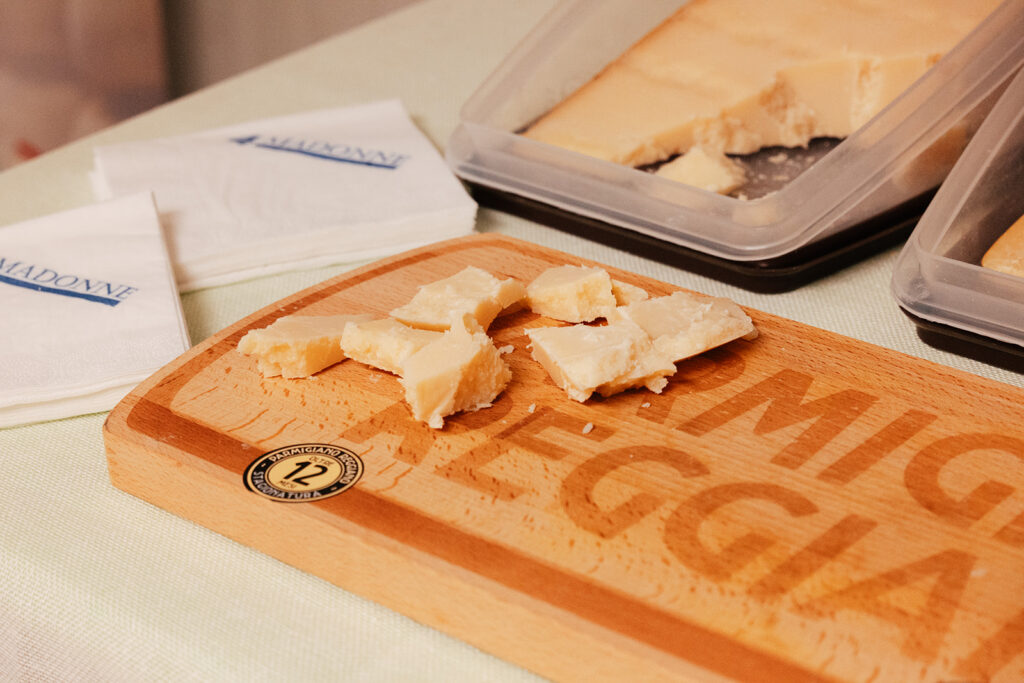
It is difficult to argue with royalty when it is handed to you in small, crystalline shards.
Then there is Lambrusco, a wine that Americans too often misunderstand because too many of us first met it in its least serious form. In Modena, Lambrusco is served daily at nearly every restaurant you walk in to. Lambrusco di Modena DOC sits in central Emilia-Romagna around Modena, and the wine is made from Lambrusco grapes grown in the province. It is built for the local table, especially the region’s rich first and second courses.
At dinner, a good Lambrusco makes immediate sense. Its bubbles cut through fat. Its fruit plays beautifully with cured meats and ragù. Its acidity stands up to cheese and pasta. It is not trying to be grand in the international wine-score sense. It is trying to be useful, convivial, and tied to the food in front of you. In a region this serious about eating, that might be the higher calling. It’s low alcohol content also means you can have a couple of glasses at lunch and still have a productive day.
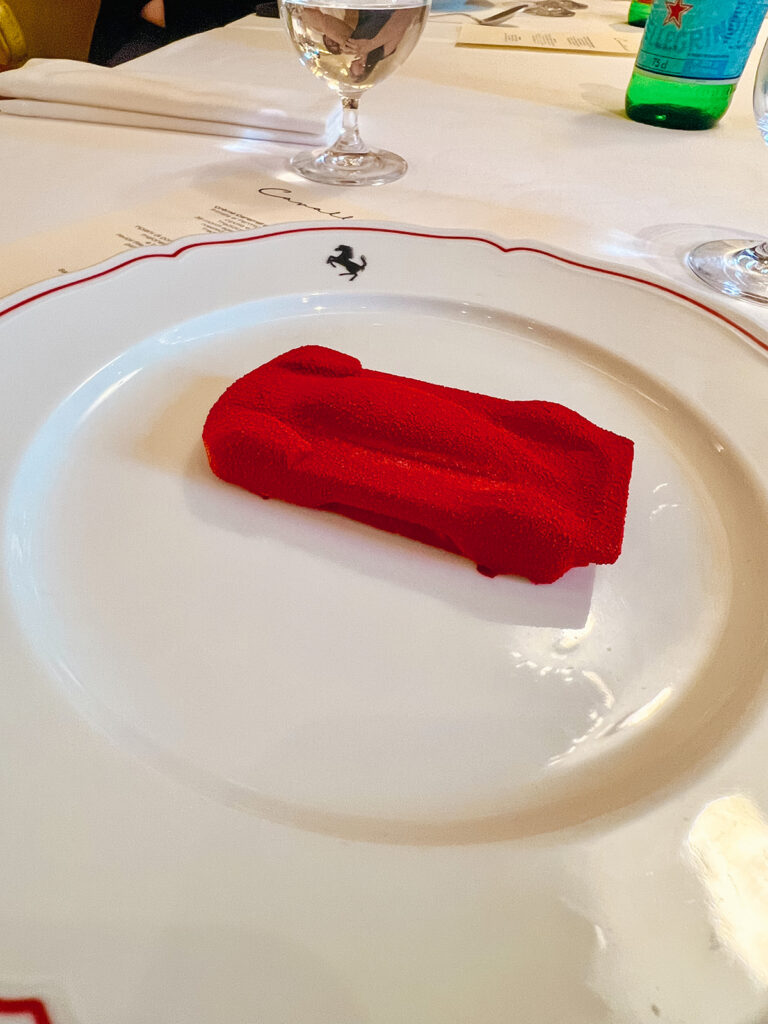
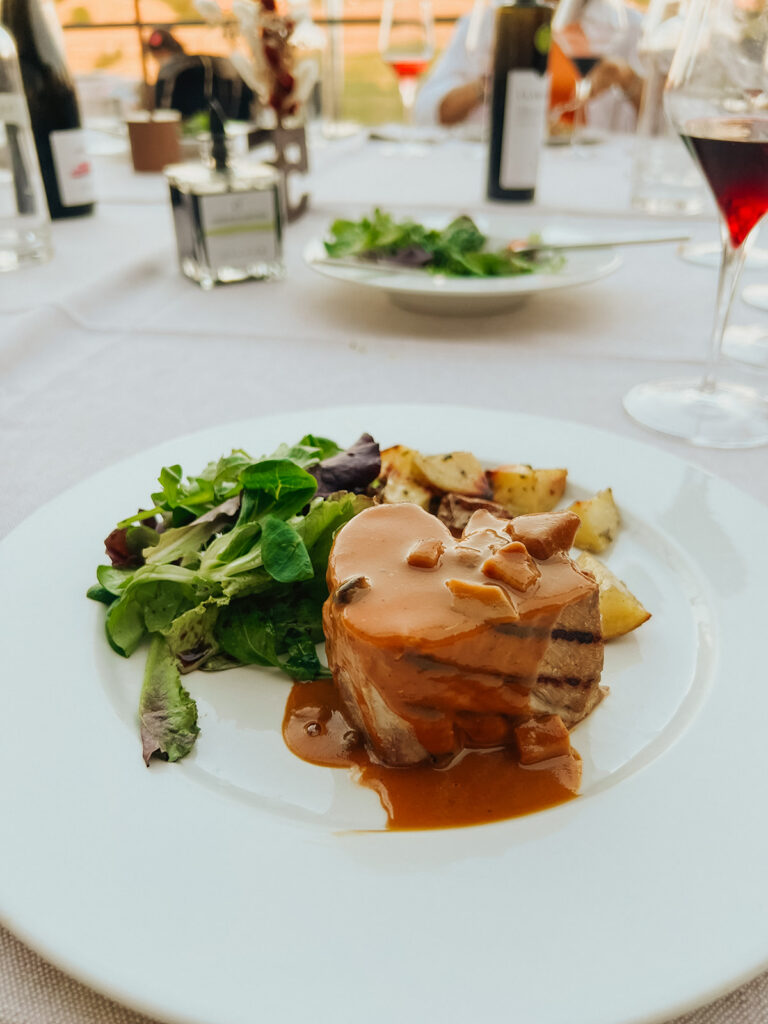
Maranello brought another kind of table with lunch at Cavallino, a restaurant whose history is inseparable from Ferrari but whose purpose is more human than brand-driven. Ferrari describes Cavallino as a restaurant that reinterprets the spirit of Ferrari inside the original walls of the first company canteen, established by Enzo Ferrari in 1950.
That history gives the room a certain charge, but the best restaurants attached to legends know when to let the food do the talking. A meal there is not merely about checking off a famous address. It is about understanding how deeply hospitality sits inside the mythology of this region. In Emilia-Romagna, even the places associated with machines eventually bring you back to pasta, wine, and the old rituals of the table. That is a very Italian kind of efficiency.
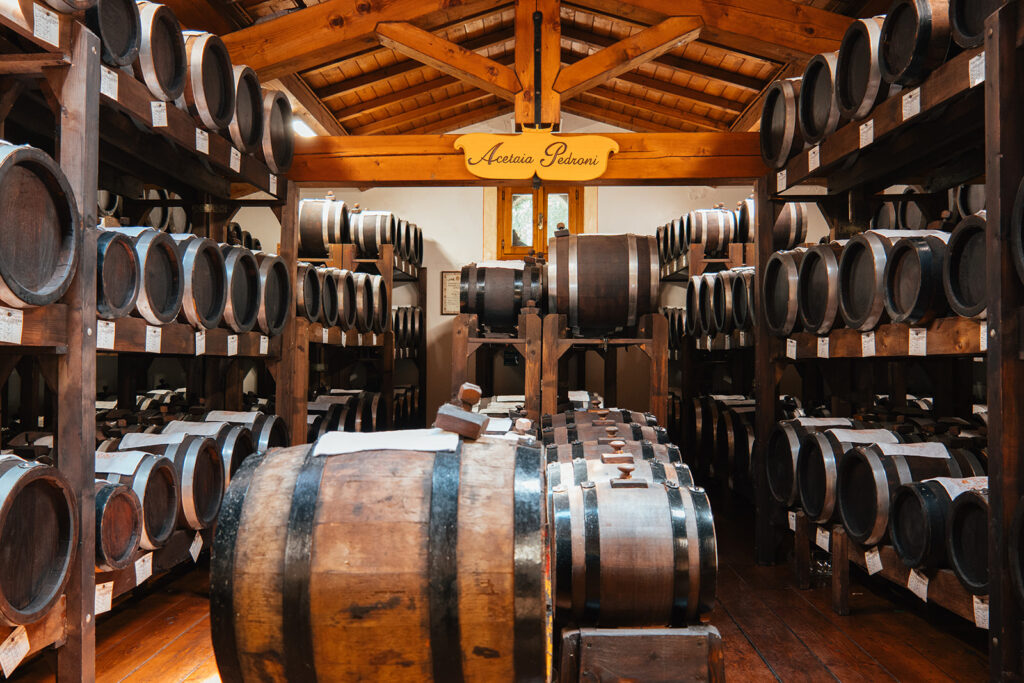
Emilia-Romagna: Its all about the Balsamic
The most memorable lesson in patience came at Acetaia Pedroni, outside Nonantola. The Pedroni family has preserved its tradition for seven generations, producing Traditional Balsamic Vinegar in the Modena countryside and serving Modenese dishes at Osteria di Rubbiara.
A proper acetaia feels almost sacred, but not in a museum way. More like an attic where time has been given a job. The barrels sit in rows, breathing through the seasons, concentrating grape must into something dark, fragrant, and astonishingly complex. Pedroni describes Traditional Balsamic Vinegar of Modena PDO as being produced from musts obtained from grapes grown in the province of Modena, including traditional grape varieties such as Lambrusco and Trebbiano.
Downstairs, Osteria di Rubbiara completes the lesson. The tavern traces its roots to the nineteenth century, when it had rights to serve food and offer stabling, and today it still serves traditional dishes such as tortellini in broth, maccheroni al pettine, strichetti with ragù, Lambrusco chicken, balsamic vinegar omelette, traditional cakes, and custard ice cream with balsamic vinegar.
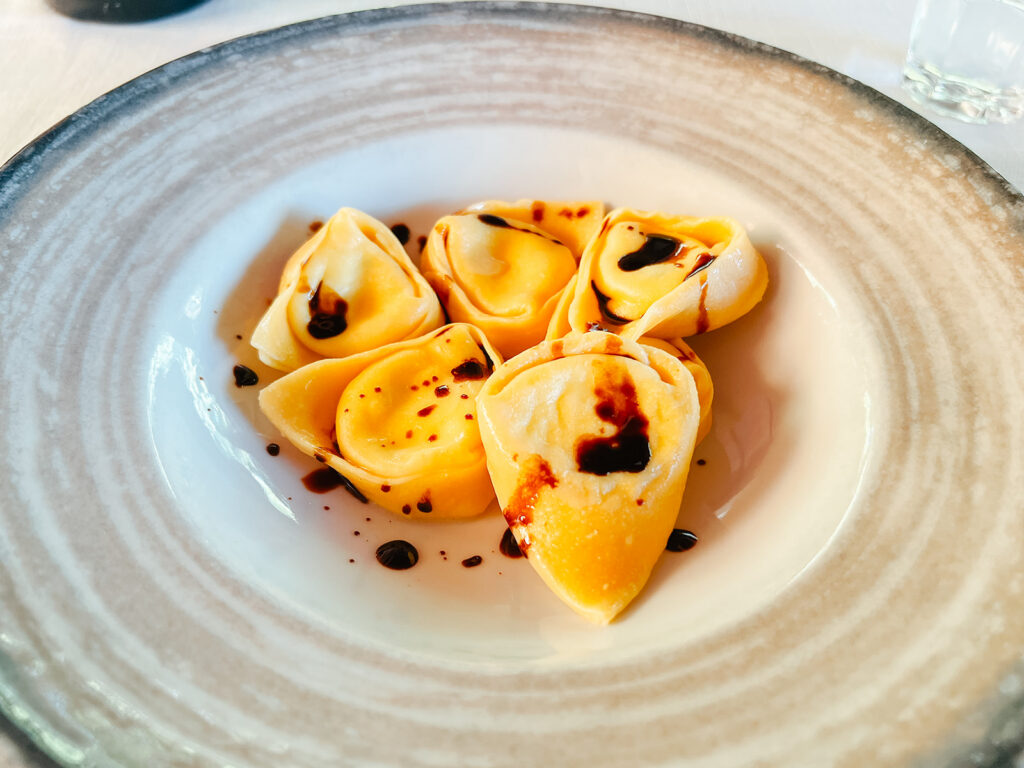
That last pairing sounds like something invented to shock tourists until you taste it. Then it becomes obvious. The vinegar is not sharp in the ordinary sense. It is sweet, dark, woody, bright, and old all at once. On ice cream, it behaves less like vinegar and more like memory with better manners.
But the meal that tied everything together was the one we did not plan.
In Modena, we crossed paths with Massimo Bottura, the chef behind Osteria Francescana and one of the great interpreters of modern Italian cooking. A simple greeting became an invitation to dinner at Casa Maria Luigia, the country house he created with Lara Gilmore outside Modena. There are invitations you weigh carefully, and then there are invitations where the only correct answer is yes, immediately, before the universe reconsiders.
Casa Maria Luigia describes itself as an intimate house in the Emilian countryside, an 18th-century property acquired by Bottura and Gilmore as an extension of the hospitality behind Osteria Francescana. They filled it with contemporary art, books, vinyl records, iconic Italian cars, motorcycles, and a pantry of Emilian ingredients.
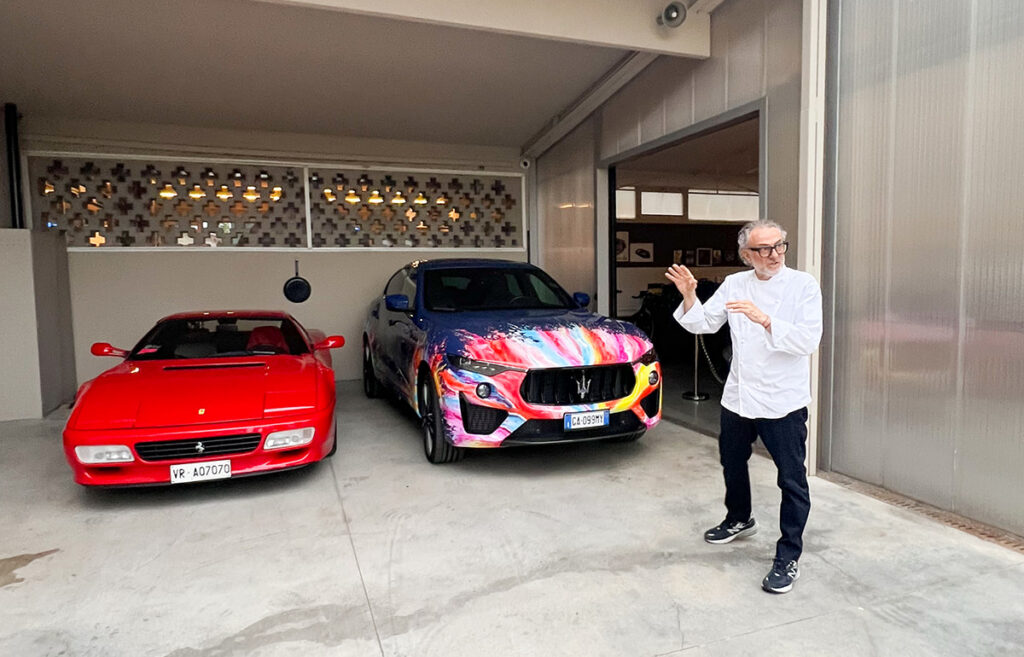
Dinner there was not simply a meal. It was a thesis on the region. The evening included a private tour through Bottura’s collection and a five-course menu rooted in the history of Osteria Francescana. The dishes moved through Pane e Pomodoro, a transformation of risotto into borlengo, Tortellini Modenesi with 36-month Parmigiano Reggiano, beef cheek with Villa Manodori extra-old balsamic vinegar, and a cherry-focused dessert named for Vignola.
What made it extraordinary was not just the cooking, though the cooking was extraordinary. It was the way the dinner made sense of everything else we had experienced on the road. The Parmigiano dairy. The acetaia. The Lambrusco. The pasta. The old tavern. The city streets. The countryside. Bottura’s genius is not that he rejects tradition. It is that he refuses to let tradition fall asleep.
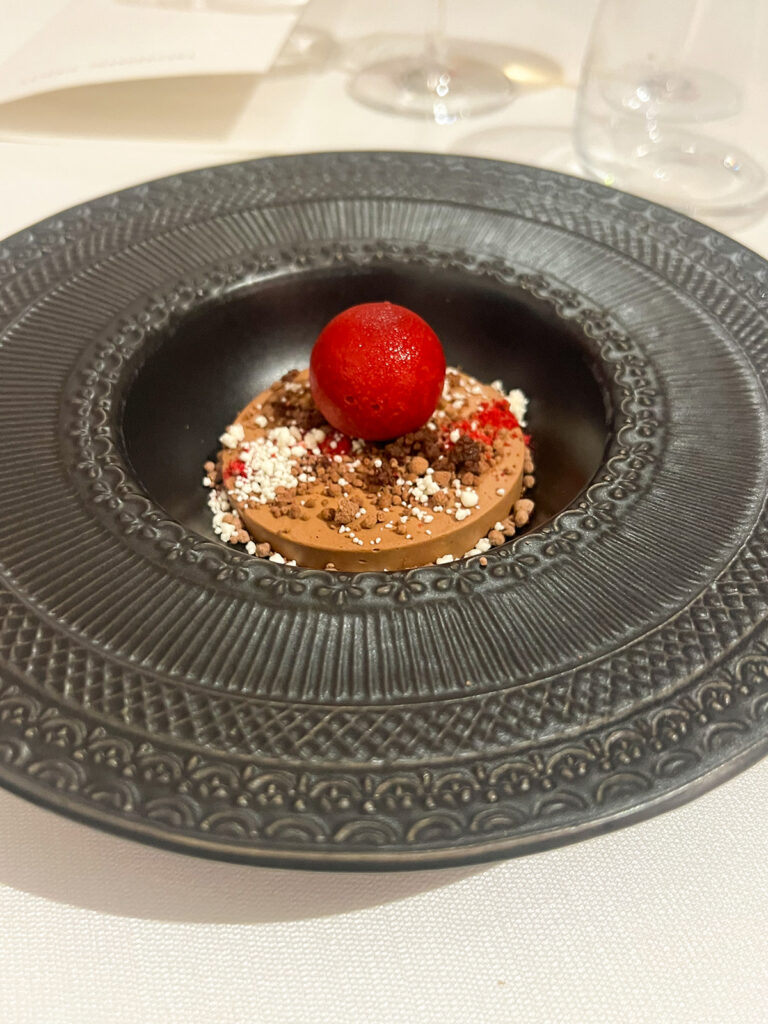
That is the great lesson of Emilia-Romagna. The past is not treated like a dusty object under glass. It is kneaded, stirred, aged, poured, grated, folded, and served again. It can be playful without being disrespectful. It can be modern without being rootless. It can sit in a centuries-old vinegar house at lunch and appear later on a fine-dining plate with the confidence of something that knows exactly where it came from.
A road trip through this part of Italy will inevitably be described by outsiders in familiar terms: food paradise, culinary capital, gastronomic heartland. All true enough, but still insufficient. Emilia-Romagna is not merely a place to eat well. It is a place that reminds you why food matters in the first place.
Food is how memory survives the century. Wine is how a table relaxes into friendship. Cheese is how a landscape turns milk into architecture. Balsamic vinegar is how time learns to behave. And dinner, when fortune is feeling generous, can become the story you will be telling long after you have forgotten which road led where.
In Italy’s Food Valley, the map is useful. Appetite is better.
Quick Facts
- Region: Emilia-Romagna, Italy
- Main Cities: Parma and Modena
- Story Focus: Food, wine, balsamic vinegar, Parmigiano Reggiano, and the culture of eating well in Italy’s Food Valley
- Key Stops: Parma, Torrechiara Castle, Modena, Maranello, a Lambrusco winery, a Parmigiano Reggiano dairy, Acetaia Pedroni, and Osteria di Rubbiara in Nonantola.
- Featured Dining Moment: An unexpected dinner with Massimo Bottura at Casa Maria Luigia outside Modena, following a chance meeting during Motor Valley Fest.
- Signature Flavors: Parmigiano Reggiano, Lambrusco, tortellini, traditional balsamic vinegar of Modena, local pasta, regional meats, and country-style Emilian cooking.
- Best For: Food lovers, road trippers, wine travelers, slow travel fans, and anyone who believes lunch should be treated with the seriousness usually reserved for constitutional law.
- Travel Style: A relaxed regional road trip built around meals, makers, countryside stops, and cultural encounters rather than a strict schedule.
- Don’t Miss: A traditional balsamic vinegar house, a Parmigiano Reggiano dairy, and at least one long dinner where nobody is in a hurry.
FAQ
What is the story about?
The story is about road tripping through Emilia-Romagna and experiencing the region through its food culture, including Parma, Modena, Parmigiano Reggiano, Lambrusco, traditional balsamic vinegar, and a memorable dinner with Massimo Bottura.
Where is Emilia-Romagna?
Emilia-Romagna is a region in northern Italy known for cities like Bologna, Parma, Modena, and Ravenna. For this story, the focus is mainly on the food-rich corridor between Parma and Modena.
Why is Emilia-Romagna famous for food?
The region is home to some of Italy’s most celebrated ingredients and dishes, including Parmigiano Reggiano, prosciutto, traditional balsamic vinegar of Modena, Lambrusco, tortellini, and tagliatelle al ragù.
What food stops are included in the story?
The itinerary includes a guided walk and dinner in Parma, lunch near Torrechiara Castle, dining in Modena, lunch at Cavallino, a Lambrusco winery dinner, a Parmigiano Reggiano dairy visit, Acetaia Pedroni, and lunch at Osteria di Rubbiara.
Is this story focused on Motor Valley?
Not directly. The original trip was tied to Motor Valley, but this story shifts the focus away from cars and motorcycles and centers on food, wine, balsamic vinegar, hospitality, and the culture of Emilia-Romagna.
Who is Massimo Bottura?
Massimo Bottura is the celebrated chef behind Osteria Francescana in Modena. In the related TGR story, a chance meeting led to an invitation to dinner at Casa Maria Luigia, the country house he created with Lara Gilmore outside Modena.
What happened at the Massimo Bottura dinner?
The dinner at Casa Maria Luigia included a private tour of Bottura’s car and art collection and a five-course menu rooted in the history of Osteria Francescana, including dishes built around bread and tomato, Parmigiano Reggiano, tortellini, balsamic vinegar, and cherries from Vignola.
What is Acetaia Pedroni?
Acetaia Pedroni is a traditional balsamic vinegar house near Nonantola, outside Modena. The itinerary included a visit to the balsamic vinegar house followed by lunch at Azienda Agricola Pedroni – Osteria di Rubbiara.
What is Osteria di Rubbiara?
Osteria di Rubbiara is the restaurant connected to Acetaia Pedroni, where visitors can experience traditional Modenese cooking alongside the family’s balsamic vinegar tradition.
What is Lambrusco?
Lambrusco is a sparkling red wine closely associated with Emilia-Romagna, especially around Modena. In the story, it appears as part of the region’s table culture, best enjoyed with rich local dishes rather than treated like a novelty wine.
What is Parmigiano Reggiano?
Parmigiano Reggiano is the famous hard Italian cheese produced in a specific area that includes Parma, Reggio Emilia, Modena, and parts of Bologna and Mantua. The story includes a visit to a Parmigiano Reggiano dairy, where the cheese-making process becomes part of the travel experience.
Is this a practical travel guide or a narrative story?
It is more of a magazine-style travel story than a step-by-step guide. The goal is to capture the feeling of eating and traveling through Emilia-Romagna rather than give readers a strict hour-by-hour itinerary.
Who would enjoy this road trip?
This kind of trip is ideal for travelers who enjoy food, wine, countryside drives, historic towns, long lunches, and experiences that feel rooted in place. It is especially good for readers who want Italy beyond the usual Rome, Florence, and Venice circuit.